
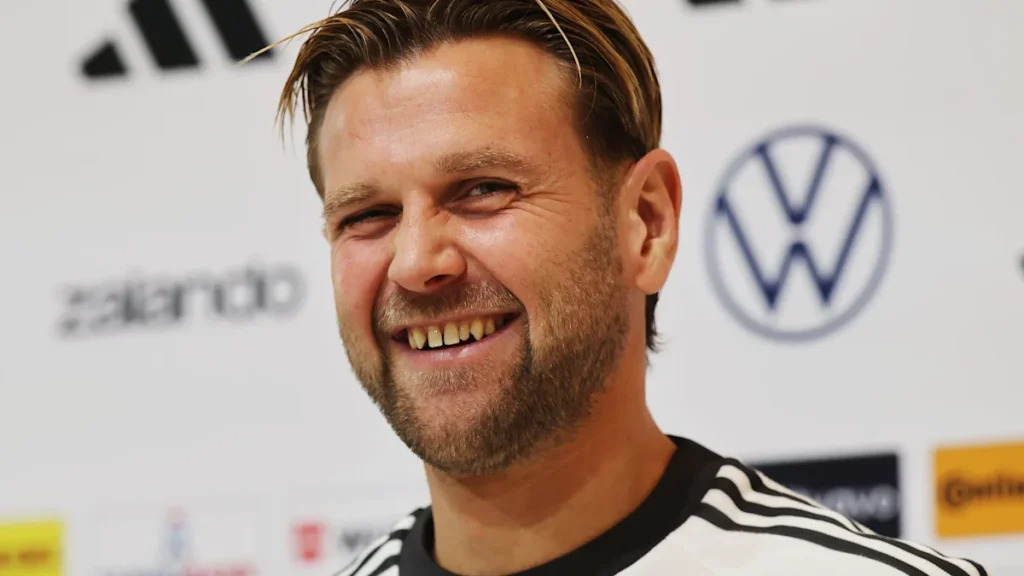
Recently recalled Germany international Niclas Füllkrug addressed questions regarding his age and the evolving demands for experienced centre-forwards at a DFB press conference in Herzogenaurach. The 33-year-old striker from Werder Bremen drew parallels to his childhood idol Miroslav Klose while reflecting on his development and the significance of experience in attacking roles.
Füllkrug’s call-up to the national team follows a stellar start to the Bundesliga season, where he netted nine goals for Werder Bremen. His performances prompted Germany head coach Jürgen Klopp to reconsider his previous reservations about Füllkrug’s long-term viability.
Advertisement
In October, Klopp remarked that Füllkrug was already 33, indicating that while he could be useful for the current squad, his future role was less certain. Since then, Klopp has retracted his earlier statements, with Klose subsequently defending Füllkrug’s position.
Earlier this month, Klose noted that he had played until 38 and even won the World Cup at 36, using his own experience to highlight how strikers can maintain productivity into their late thirties. Klose praised Füllkrug’s scoring ability, presence on the field, and leadership skills.
In response to the initial inquiry about his age, Füllkrug stated, “My age is a fact. But I found it very interesting what Miro [Miroslav Klose] said about that. Miro was one of my idols as a kid. I got a chance to see him [compete] when he was 36, 37, 38. He won the World Cup at 36. I found it interesting what he said on the matter, and he speaks from experience.”
“When the Bundestrainer made his comment [about my age], I didn’t take offense to it at all,” Füllkrug added. “The Bundestrainer has many tasks before him, and one of them happens to be, in our [Germany’s] current situation, to find and develop younger players. I find it basically positive that we have a lot of [young] strikers making an impression with their clubs.”
Advertisement
Füllkrug Addresses Influence of Harry Kane and Modern Forward Play
Füllkrug also spoke about his evolving responsibilities at the club level, particularly regarding his tendency to drop deeper into midfield and engage more in Werder Bremen’s attacking build-up.
When asked if his recent play reflected the influence of Bayern Munich’s Harry Kane, who combines traditional centre-forward duties with creative contributions, Füllkrug dismissed the notion of emulating the England international. He emphasized that his tactical roles depend more on his teammates’ strengths and the specific challenges posed by different opponents.
Advertisement
“I’m playing the way I’ve been playing for a few years now,” Füllkrug shared with Florian Plettenberg. “It’s just more noticeable because I’m currently playing for a team that I can help out [with my deep drops].”
“When I was playing for AC Milan and Adrien Rabiot and Luka Modric were playing behind me, they took care of it,” Füllkrug elaborated. “They had the solutions. They didn’t need me in the No. 10 slot or farther back. We entered most games as the favorites and always had more ball possession. It was a lot like that at BVB.”
“At Werder, we’re not the favorites in most games,” Füllkrug concluded. “It’s thus important that we all take as much responsibility as possible all over the pitch. I believe I have the quality to play football in these areas [of the pitch] as well. Accordingly, I’m happy that it’s being observed and recognized. Strikers can contribute a lot outside of scoring goals.”
Füllkrug Outlines Reasons for Late-Stage Peak in Strikers
The Germany international also shared insights about why certain strikers might peak later in their careers. In response to a question about his relatively late emergence on the international scene and how it relates to players like Deniz Undav and Tim Kleindienst, Füllkrug highlighted a broader trend of gaining significant experience in domestic football prior to national team opportunities.
Advertisement
Rather than viewing advancing age as a disadvantage, Füllkrug argued that the demands of the centre-forward position can actually benefit from accumulated experience.
“I do believe that is the case to a certain extent,” Füllkrug responded when asked about the late international entries of players like Undav and Kleindienst. “Because so much about this position is mental. There’s reaction speed, timing, experience, and a ‘feel’ for things.”
“Naturally, the longer you’ve racked up consistent playing time and the more games you’ve assembled, the better your feel for certain situations will be,” Füllkrug continued. “You’ve been in these situations before. You know how the defenders move, and you’re more effective at utilizing your strengths. I don’t think any of the players you listed were great speedsters who lost their best weapon with age.”
“We [Germany] have always had strikers who put in top performances at a later age,” Füllkrug concluded. “I mentioned that [with Miroslav Klose] at the beginning. Internationally, there are always many strikers who are performing at the top level in their late 30s, and yet age is still an issue. For me, it’s not an issue. I don’t feel 33, and when I read about people saying that I’m ‘already 33’, I just have to say, ‘That really can’t be that bad’.”